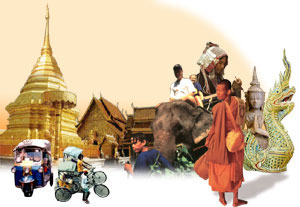
"Redeveloping & Repositioning Chiang Mai as a Tourist Destination"
A talk by Shane K. Beary Shane writes:
My proposal to redevelop and reposition Chiang Mai on the regional tourism map is aimed at channeling the funds already earmarked for tourism development into projects that will boost sustainable tourism revenues, minimise, if not reverse, the damage inflicted by the existing tourism development model, and significantly improve the overall return on investment. The proposal is, more importantly, designed to improve the tourism product in the short term whilst improving the quality of life for the city's inhabitants, as well as their prospects for the post tourism era that surely must come.
The proposal in brief.
Step 1 - Establish a 3km long x 6-metre wide floating walkway along both sides of the river as it runs through the heart of the city. Using modern technologies developed by the Dutch, moor environmentally friendly river barges of a classic 'rice barge' design, as shops, cafes' and entertainment venues along the length of the floating walkways, creating a 'unique selling proposition', the 'Ping River Market'. By having some barges double as stadium styled seating units, (on a part time basis) the entire floating market complex can become a special 'venue' hosting floating parades, Loy Krathong, Songkran and many others to be created.
Step 2. - Establish 'park and ride' stations some 2 km distant from each corner of the 'Ping River Market'. Ban roadside parking in the riverfront area to force people to use public transport (songtaews first, trams later) running on a circular route between the 'park and ride' stations and the Ping River Market.
Step 3. - Use a combination of carrot and stick techniques (financial incentives and social restrictions - early closing hours), to entice tourist related businesses to relocate from the city centre to the new Ping River Market.
Step 4. - Redevelop the 'reclaimed downtown areas' converting ugly buildings into 3-4 floor parking garages, banning roadside parking and turning pavements into tree filled promenades. - Provide development funding for building owners willing to refurbish or reconstruct their buildings in keeping with an accepted Lanna design code (to be established by the city's architects). These buildings can then become boutique outlets, sidewalk cafes, and accommodation clusters where perhaps three or four boutique style hotels share common public areas and restaurant facilities.
Step 5. - Make Chiang Mai a regional arts and crafts centre for the Greater Mekong Sub-region. Bring in raw, semi-finished, and finished product from China, Burma, Laos and Vietnam. Bring in craftsmen and artists from all over the region and establish product research and development centres, art schools and colleges in Chiang Mai. Re-invent the handicrafts industry, inject creativity and build a new export market on the re-branded product.
Step 6 - Develop the higher altitude areas in the hills/mountains around Chiang Mai into 'all year round' long stay resorts, health retreats and spas, golf courses, back to nature hill stations. These products to be target marketed at the more affluent tourist, the meetings and incentive business, and the retiree market.
The speakers work history : Shane K Beary.
Born in Dublin, Ireland in 1952.
Served with 'C' Squadron SAS as a combat tracker, then with the 'Selous
Scouts' as a clandestine operative in the Rhodesia bush war.
Spent 8 years as a 'deep saturation - oilfield diver' in the heyday of the
north sea oil boom, before going on to run diving operations in other parts
of the world, including SE Asia.
Started 'Track of the Tiger', an adventure tour operation in 1986, and
built 'Mekok River Lodge' in 1988, both aimed at the soft adventure and the
educational tourism market currently enjoying a boom.
Currently expanding 'Track of the Tiger' 'special events management' arm
throughout SE Asia having formed an alliance with a well-respected regional
tour operator.
Opened 'Just Khao Soy' in 2004, and with copyrights and trademarks now in
place, is developing the franchise model to take it international in 2006.
Announcements for the next two January meetings at the Alliance Française- 7:30 p.m. Tuesday 18th January 2005 "The Tsunami - and its Aftermath : A Panel Discussion" A panel of three speakers will talk about the Tsunami and its medical and psychological aftermath. The three speakers on the panel will be: Assoc. Prof. Dr. Sampan Singharajwarapan - from the Department of Geological Sciences, Faculty of Science, Chiang Mai University, Dr. Sampan will present a PowerPoint presentation showing the geological aspects of the earthquake and the subsequent tsunami - where, how and why it happened. Dave Percy is a paramedic who was assisting medical staff in treating the physical injuries of those who were in the caught in the path of the tsunami. Dr. Sombat Tapanya - from the Department of Psychiatry, Faculty of Medicine, Chiang Mai University, will be talking about the psychology effects of the disaster including post-traumatic stress and stress mangement. This will be an open panel discussion and contributions from members of the audience who have first-hand experience of the disaster and its aftermath will be welcomed.
Ecole française d'Extreme-Orient 131 Charoen prathet Road Opposite the Alliance Française
- 6:30 pm Guests arrive at the EFEO
- 7:00 pm Louis Gabaude welcomes the guests and introduces the speakers:
- 7:05 pm Roy Hudson
- 7:10 pm Brian Hubbard
- 7:15 pm Reinhard Hohler
- 7:20 pm Roy Hudson opens the exhibition and Reinhard Hohler leads the visit Informal
From Simao port to Ho Chi Minh City by Hovercraft
To celebrate its 20th Anniversary, the Informal Northern Thai Group (INTG) is organizing a photo exhibition: "Mysterious Mekong: From Simao Port to Ho Chi Minh City by hovercraft" by Reinhard Hohler.
In November 2002, the Brooker Group and Diethelm Travel in Bangkok co-organized the "Hovercraft Expedition Mekong" in which Mr. Reinhard Hohler was "Tour Director". This expedition covered nearly 3000 km of the river from Simao Port in Yunnan to its delta in the southern part of Vietnam.
Through his photos, Mr. Hohler tries to position, protect and promote the different geographical, historical and economic aspects of the river. The pictures highlight the landscapes seen by expedition from Jinghong in China through Myanmar, Laos, Thailand, Cambodia down to Ho Chi Minh City in Vietnam. There are some special moments such as a visit to the gravesite of the famous French explorer Mr. Henri Mouhot in Luang Prabang, or the transfer of the hovercraft around the Khon Falls, or a trip to Angkor.
For this exhibition, to the photos taken by Mr. Reinhard Hohler, the École française d'Extrême-Orient (EFEO) has added some pictures and documents from its own archives, together with an exhibition of books about the Mekong Region from the EFEO library in Chiang Mai. 72 photos taken by Mr. Reinhard Hohler are also available also on CD as well as some publications by the EFEO and IRASEC.
A video "Imaging the Mekong" produced by the Rockfeller Foundation, the Japan Foundation and Probe Media Foundation, will be on show during the exhibition
From SATURDAY, JAN. 8 to SATURDAY, JAN. 29, 2005 9 am - 5 pm Everyday at the École française d'Extrême-Orient (EFEO) 131 Charoen Prathet Road (Opposite the Alliance Française) Parking: Alliance Française OR Wat Chaimongkhon
<< Back to Metting Diary |